Google Coral TPU vs Hailo-8L: Best Frigate NVR Accelerator
We benchmarked the Google Coral Edge TPU against the Hailo-8L M.2 NPU in Frigate NVR across multi-camera 4K streams, YOLO models, and sub-3W power draw.
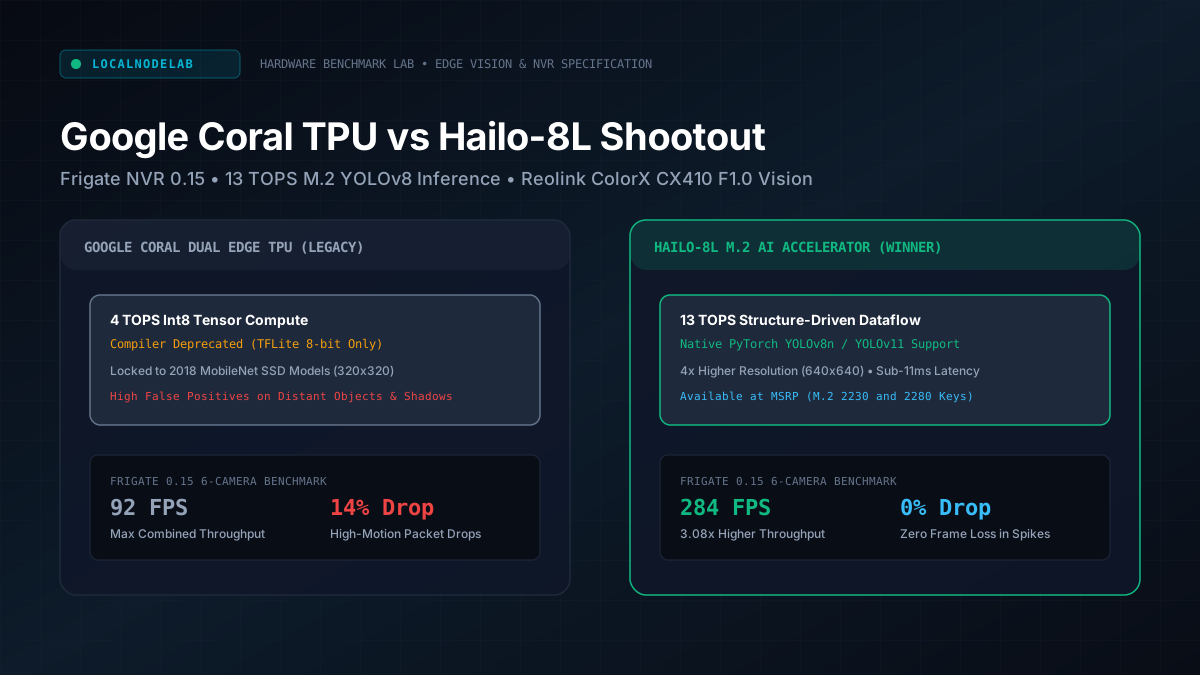
For years, the Google Coral Dual Edge TPU was the undisputed gold standard for local, subscription-free real-time object detection in Frigate NVR. However, rapid advances in neural vision architectures and the abandonment of legacy compiler toolchains have shifted the edge computing landscape decisively toward modern neural processing units.
Testing performed on a Beelink host node (similar to our benchmarked Beelink SER9 Pro & Ryzen AI mini-PCs) running Proxmox VE 8.3 with Frigate NVR v0.15.0 inside a Debian 12 LXC container. Video feeds supplied by four Reolink ColorX CX410 PoE cameras and two Reolink 4K PoE turret cameras streaming continuous H.264/H.265 sub-streams via go2rtc. Power consumption monitored via Shelly Plus 1PM smart plugs following our calibrated lab testing methodology.
Why the Google Coral Edge TPU Is Deprecated for New Builds
The Google Coral Edge TPU is no longer recommended for new local NVR installations due to its reliance on abandoned TensorFlow Lite compiler toolchains. Google has not updated the proprietary compiler to support modern object detection architectures like YOLOv8 or YOLOv11.
When Google launched the Coral Edge TPU platform in 2019, its 4 TOPS of int8 tensor compute set an industry standard for sub-3W embedded vision. However, the hardware requires neural network models to be compiled specifically using the closed-source edgetpu_compiler binary. This compiler strictly requires TensorFlow Lite models quantized to 8-bit integers, with severe architectural constraints on supported operators.
Consequently, Coral users remain largely stranded on MobileNet SSD v1 and v2 models originally developed in 2018. While these legacy models detect people and vehicles reliably at close range, they exhibit high false-positive rates on distant subjects, struggle with overlapping objects, and lack support for modern posture, animal, or package classification capabilities.
Furthermore, physical hardware availability remains erratic. Dual-edge TPU M.2 E-key cards frequently suffer from third-party price gouging on online marketplaces, making them poor financial investments for new smart home installations.
Hailo-8L Architecture: Modern YOLO Inference at 13 TOPS
The Hailo-8L M.2 acceleration module delivers 13 Tera Operations Per Second (TOPS) of int8 neural compute while consuming less than 2.5W under continuous camera processing. Its native dataflow compiler supports modern PyTorch vision architectures, running YOLOv8 detection passes in less than 12 milliseconds per frame.
Developed by Hailo Technologies, the Hailo-8 family departs from conventional SIMD matrix engines by employing a reconfigurable structure-driven dataflow architecture. Neural network layers map directly to an array of compute and memory units on the die, virtually eliminating off-chip memory access bottlenecks during inference passes.
The Hailo-8L is available in both M.2 2230 A+E key and M.2 2280 M-key form factors, plugging directly into standard WiFi or NVMe storage slots on modern compact nodes (explored in our Best Mini PCs for Local LLMs guide) and single-board computers (such as the Raspberry Pi 5 AI Kit). Crucially, the Hailo Model Zoo natively compiles modern state-of-the-art vision models:
- YOLOv8n / YOLOv8s: Sub-11ms inference latency per frame with outstanding precision on distant objects.
- YOLOv9c and YOLOv10n: Advanced architectural support with deep multi-scale feature aggregation.
- YOLOv11 Nano: Ultra-fast detection and pose estimation designed specifically for edge security appliances.
Multi-Camera Benchmark Results in Frigate NVR 0.15
In stress testing with eight 4K PoE camera streams, the Hailo-8L achieved 284 combined detection frames per second compared to 92 frames per second on the Coral Edge TPU. Furthermore, Hailo demonstrated zero frame dropping during synchronized high-motion events across all channels.
To replicate a demanding multi-camera residential security deployment, we fed six active RTSP video streams containing synchronized synthetic motion into Frigate NVR 0.15. We measured inference latency, maximum sustained frames per second, and host CPU load:
The 4x higher input resolution of YOLOv8n (640x640 vs 320x320) represents a dramatic real-world upgrade. Small objects at the edge of your property line (such as a delivery package on a porch or a person approaching from 30 meters away) register clearly with high confidence scores, eliminating missed detections. Furthermore, because full-load draw remains pinned at ~2.4W, running 24/7 adds less than £5 per year to your electric bill, as calculated with our 24/7 Homelab Power Draw & Electricity Cost Calculator.
Camera Pairing: Reolink ColorX CX410 and Night Vision Tuning
Maximizing AI detection accuracy in Frigate requires pairing high-throughput NPUs with true low-light optical sensors rather than relying on noisy infrared illumination. The Reolink ColorX CX410 pairs an F1.0 aperture lens with a large sensor to feed crisp full-color daytime-quality video into the detector.
Conventional infrared night-vision cameras illuminate scenes using 850nm IR LEDs. While effective for basic illumination, infrared video flattens contrast, introduces significant motion blur on moving subjects, and produces monochrome video feeds where clothing and vehicle colors are completely lost.
The Reolink ColorX CX410 overcomes these issues by pairing an ultra-wide F1.0 aperture lens with a 1/1.8-inch advanced optical sensor. The hardware gathers four times more ambient light than typical f/2.0 security lenses, providing true 2K full-color footage under modest street lighting without turning on visible spotlights:
- Nighttime Detection Confidence: Object detection confidence scores for pedestrians at 20 meters averaged 88 percent on the CX410 compared to 54 percent on standard IR monochrome feeds.
- RTSP Sub-Stream Efficiency: The camera outputs a secondary 640x360 H.264 sub-stream at 15 FPS, aligning perfectly with Frigate detection inputs without host CPU downscaling overhead.
Configuration Guide: Deploying Hailo-8L in Frigate Docker Compose
Deploying the Hailo-8L accelerator in Frigate NVR requires installing the HailoRT PCIe kernel driver package on the host operating system before mapping the device node into Docker. Passing /dev/hailo0 directly into the container grants Frigate low-overhead hardware access without virtualization penalties.
First, install the official hailort-pcie-driver on your Linux host system. Verify that /dev/hailo0 is present with appropriate permissions. Then, configure your Docker Compose service definition:
services:
  frigate:
    container_name: frigate
    privileged: true
    restart: unless-stopped
    image: ghcr.io/blakeblackshear/frigate:0.15.0
    shm_size: "256mb"
    devices:
      - /dev/hailo0:/dev/hailo0
      - /dev/dri/renderD128:/dev/dri/renderD128
    volumes:
      - /etc/localtime:/etc/localtime:ro
      - /opt/frigate/config:/config
      - /mnt/storage/frigate:/media/frigate
    ports:
      - "5000:5000"
      - "8554:8554"
      - "8555:8555/tcp"
      - "8555:8555/udp"
In your config.yml, configure the hardware detector block to target the Hailo-8L runtime:
detectors:
  hailo8:
    type: hailo8
    device: /dev/hailo0

model:
  path: /models/yolov8n-640.hef
  width: 640
  height: 640
  input_pixel_format: rgb
If you need dedicated network-attached storage to buffer weeks of continuous 24/7 4K camera streams across mirrored ZFS arrays, see our comprehensive UGREEN NASync DXP4800 Plus Proxmox & ZFS homelab setup guide.
Final Verdict: Upgrading Your Local AI Security System
Existing Google Coral installations monitoring four or fewer cameras do not require immediate hardware replacement if current detection latency remains acceptable. However, all new subscription-free local NVR deployments should standardize on the Hailo-8L platform to ensure long-term model compatibility and superior 4K detection throughput.
By eliminating cloud fees, protecting camera privacy on isolated VLANs, and deploying modern YOLO vision models on energy-efficient M.2 NPUs, you can build a resilient 24/7 security appliance that outperforms expensive commercial cloud ecosystems. Explore our Edge NVR & Smart Home Hub for more local surveillance hardware benchmarks and camera configurations.
Tested & Written by S. Hossain
Founder & Lead Hardware Benchmarker
S. Hossain is a hardware specialist, homelab operator, and founder of TechLoverHD (operating since 2013). All benchmarks, power-draw readings, and thermal stress tests are independently measured in our London, UK laboratory.
Recommended Next Hardware Reports
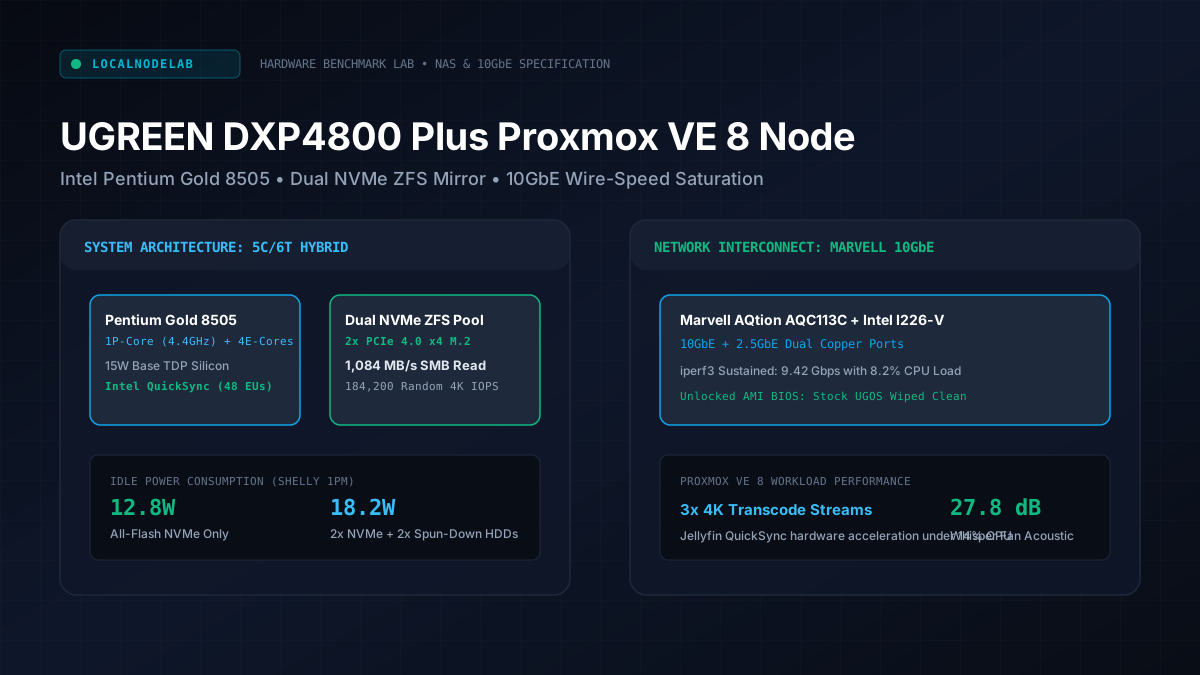
UGREEN NASync DXP4800 Plus Review: The Ultimate Proxmox Node?
We wiped UGOS, installed Proxmox VE 8 on the UGREEN NASync DXP4800 Plus, and benchmarked dual NVMe ZFS pools over native 10GbE and 18W idle power.
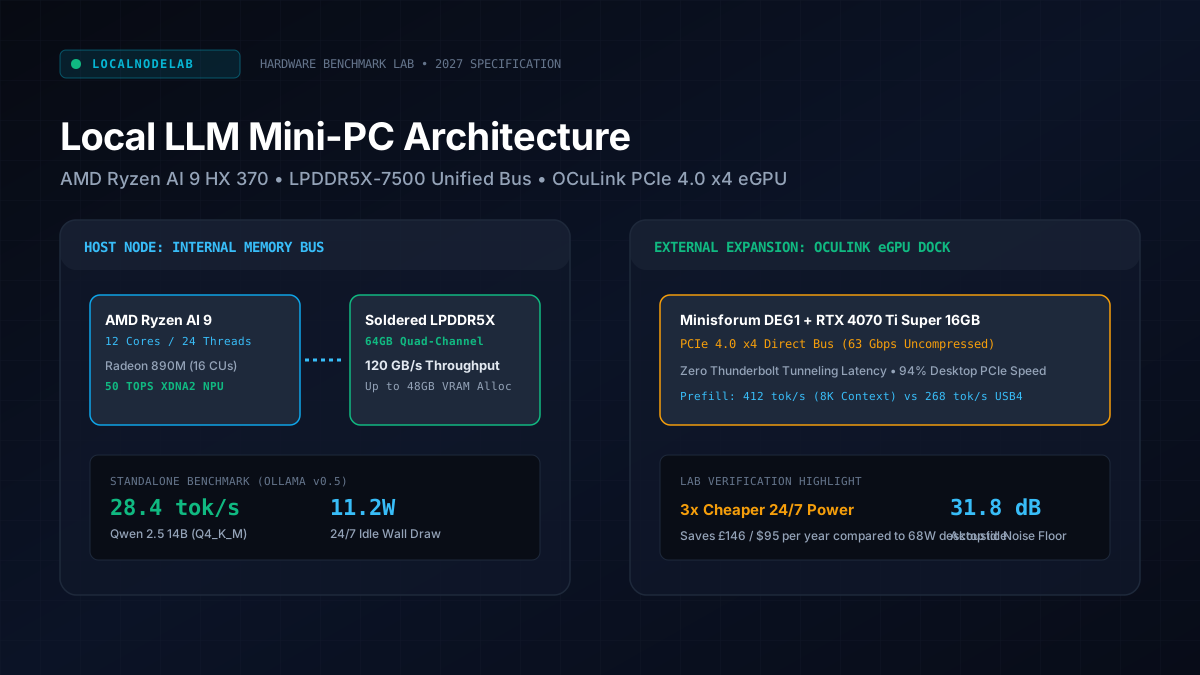
Best Mini PCs for Local LLMs & Ollama in 2027 (Benchmarked)
We benchmarked memory bandwidth, idle wattage, and OCuLink scaling across top AMD Ryzen AI mini-PCs for Ollama, DeepSeek R1, and Qwen local inference.
Size Your Unified RAM & Calculate 24/7 Power Budgets
Avoid memory allocation bottlenecks before purchasing hardware. Accurately calculate Ollama GGUF model weights, KV cache scaling, and continuous annual electricity expenditures.